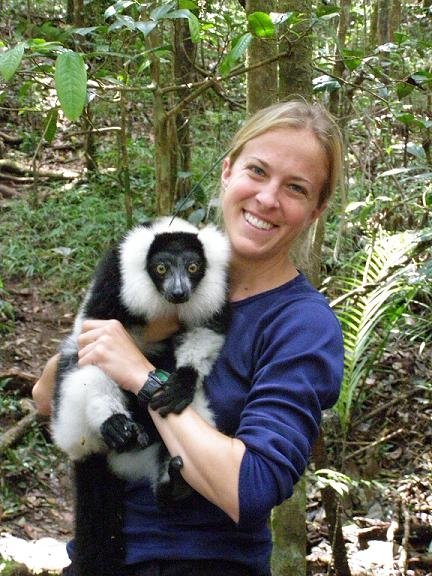
Andrea Baden and the Black-and-white Ruffed Lemur

Andrea Baden and Varecia
“In college, I had trouble deciding what I wanted to be when I grew up. I bounced around from elementary education to photojournalism to creative writing. I knew I loved nature, I knew I loved adventure and travel, and I thank my lucky starts that my undergrad advisor, Linda Taylor, recommended this trip to Madagascar. It changed my life.“

Squish, squish, squish. Andrea Baden’s boots moved gracefully across the rainforest floor. It was late July, and pools of water were forming on the soggy ground in Madagascar’s Ranomafana National Park.

But her attention wasn’t on the mat of leaves, sticks and ferns underfoot. Andrea was scanning the canopy above for the animals that would change her life… the rare and beautiful black-and-white ruffed lemurs.

Andrea became intrigued by Madagascar in school. As she learned more and more about this unique and isolated place, Andrea knew she had to see it for herself. Her dream became a reality at age twenty, when she worked with her professors at the University of Miami to plan a trip to this far-flung island nation. Andrea was a photojournalism major, and she was about to apply what she’d learned to an amazing real-world experience: she would create a photo-documentary on the people of Madagascar.

After months of planning, Andrea and her team left New York’s JFK airport on September 10, 2001. She was awash with excitement, expectation, and responsibility for the project ahead.

She was already deep in a rainforest jungle on the other side of the world when she learned of the “9/11” attacks. Several of her team members had family in New York. At that time, communication in Madagascar was very limited. Andrea and her team had to drive 1.5 hours from the rainforest to the nearest town to buy a phone card. Then they had to stand in line to use an unreliable pay-phone to try to connect with their families.

The team spent a tense night deciding if they would stay in Madagascar for three months as planned, or if they would return home. They stayed, and Andrea calls it her “best decision ever.”

To Andrea’s surprise, the inhabitants that captured her imagination over those three months were not the native Malagasy people, but other natives with cold noses, inquisitive faces, and non-prehensile tails. She had fallen in love with lemurs.

As she spent more time with lemurs, Andrea decided that rather than photograph lemurs, she wanted to understand them. Their social structure. Their diet. What makes them unique.

By the time her flight landed back in Miami, Andrea had made up her mind. She was going to become an expert on lemurs. She immediately changed her major to study Anthropology. The catch? She was well into her Junior year at the University of Miami, and she had little time to complete the requirements of the major and still graduate on schedule.

Fueled by her love of lemurs and an intense curiosity, Andrea doubled-up on difficult courses and studied insatiably. She accomplished her goal.
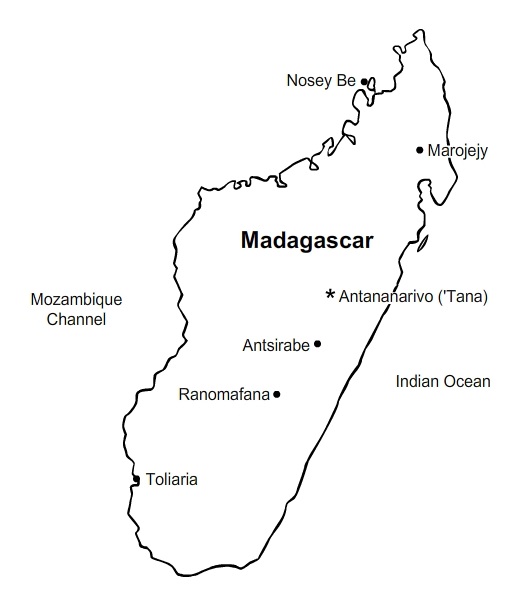
image18_remost recent_cropped

When she returned to Madagascar after college, Andrea assisted scientists studying lemurs, leaf geckos, and exotic birds. In the evenings, around the dinner table at the camp, she heard her colleagues discuss ideas for new research projects. She saw those projects become new discoveries, and realized that textbooks were only a small part of science. The real science happens all around us every day. She decided to be a primatologist.The experience stuck with Andrea, and after college she applied to work with world-renowned primatologist Dr. Patricia Wright, a professor at Stony Brook University, studying black-and-white Ruffed lemurs and their babies.

It seemed like a logical choice. In addition to being one of the world’s foremost experts on lemurs, Dr. Wright was also responsible for the creation of Ranomafana national park… a place where Andrea had initially fallen for lemurs. Dr. Wright has continued to lead the charge in learning about lemurs. She is the driving force behind Stony Brook University’s Centre ValBio research facility in Ranomafana, and was recently featured in IMAX’s Island of Lemurs: Madagascar film.

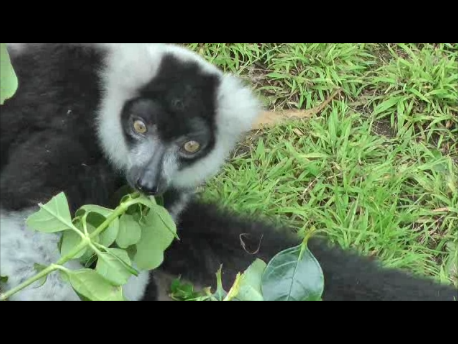
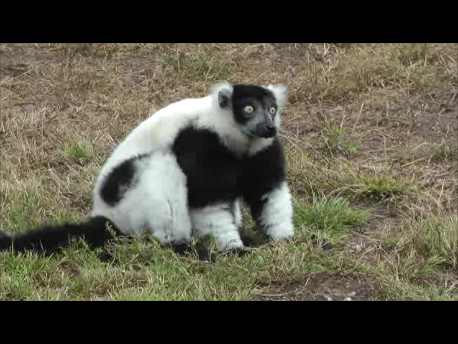
So just who are these black-and-white ruffed lemurs?
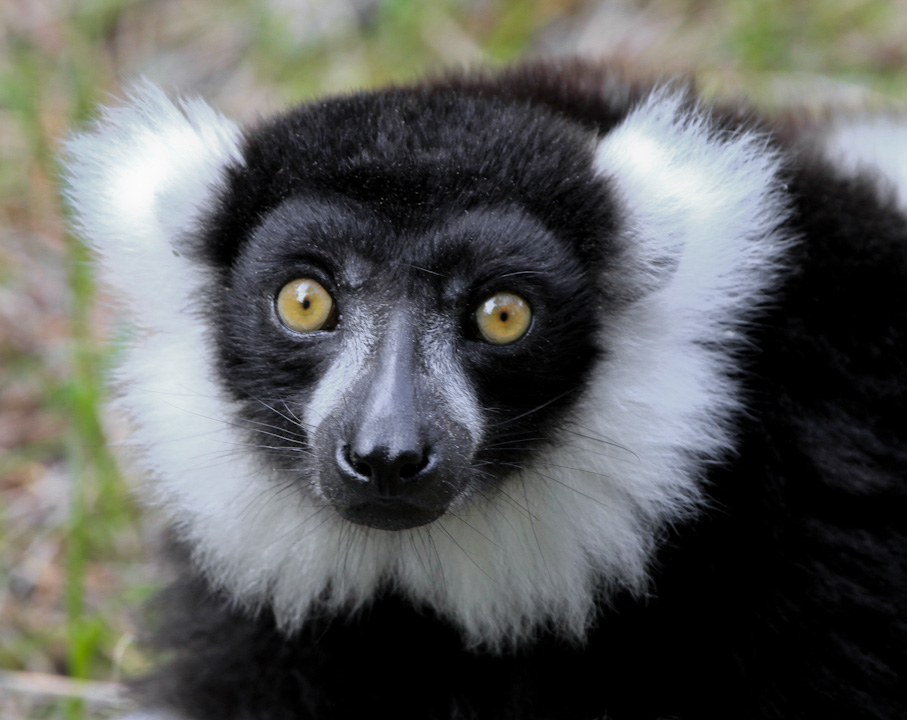
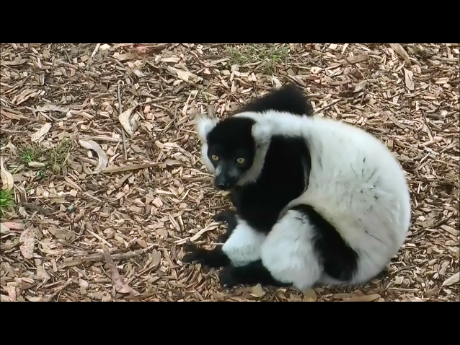
© NRoweTo see video of black-and-white ruffed lemurs, click here.

Like all lemurs, black-and-white ruffed lemurs are only found in the wild in Madagascar. They reside in the eastern rain forest corridor from the north to the south of Madagascar. In particular, they can be found in Manombo Reserve, Ranomafana National Park, Mantadia National Park, and Betampona Reserve.

Their diet is 95% fruit, and they guard fruit trees by roar-shrieking. You can find the link to that here. They have two or three offspring every two to six years, depending on fruit availability. Black-and-white ruffed lemurs live in troops of 18 to 30 individuals. These lemurs are diurnal, meaning they are active during the day and they sleep at night. (Though there is some evidence of cathemerality – activity throughout a 24-hour period – on moonlight nights.)

Black-and-white ruffed lemurs fluff makes them look larger than a house cat, but when you hold them, you quickly realize that there’s not much ‘body’ under all that fluff. Young animals are ~3kg (6 to 7 lbs), but mature adults can be as large as 4.7kg (10.4 lbs). Interestingly, their body weight changes significantly throughout the year depending on how much food is available.

Unlike other lemurs, black-and-white ruffed lemurs have babies in litters of two or three. While most lemur babies cling to their mothers, B&W ruffed lemurs do not. They reside in nests high in the rainforest canopy, where mom cuddles them and gives them milk. Mothers carry the babies by mouth like a mother cat carries her kittens.

As the babies grow larger, feeding the babies becomes more taxing for the mother, and she must spend more time away from them gathering food for herself. Before going out to forage, these lemur moms warn their babies to be quiet so they are not found and eaten. But, babies being babies, they often vocalize (cry) or curiously stick their heads out of the nests when unsupervised. When this happens, unattended baby lemurs become targets for predators.

Patience and Determination
ruffed_andrea (2)

Lemurs are the most endangered primate group in the world, and scientists became interested in finding ways to reduce infant mortality in lemurs. Scientists have long thought that cooperation evolves between lemurs through “kin selection,” or close genetic relationships among family members. The theory is that lemurs would be more likely to help their sister or mother with costly behaviors (e.g., behaviors that their own well-being at risk, either by placing themselves in harm’s way, reducing their energetic intake) than they would be to help a non-related lemur.

Andrea designed an experiment on infant care, and identified a troop of lemurs to study. Andrea’s insight involved radio-tracking mothers. Because the black-and-white ruffed lemurs nest high in the rainforest canopy, scientists knew little about how they are reared in the wild.

Her team applied radio collars to the lemurs. Then they waited. And waited.

The first year came and went, and but not a single baby was born in the troop. Her luck did not improve in the second year.

Not easily discouraged, Andrea pressed on, and in the third year of the study… still nothing.

When no babies had been born after the fifth year, Andrea reluctantly set aside her tenacity and decided to shift the study to look at a different aspect of lemur behavior. Why do certain individuals choose to hang out with each other?

A few months into this new study, a strange thing happened. Several litters of baby lemurs arrived! Andrea quickly dusted off her old study, and, with ample subjects in collars, the research she had long sought began!

Lemur Kindergarten
All the lemurs in the area were already collared, so they knew specifically who was interacting with whom. They were able to follow mothers from the time they woke up in the AM to the time they went to bed.

Not only did Andrea’s team follow the mothers, they “followed” their nests. This was the first time someone had marked, mapped and staked out trees to observe behaviors in the absence of the mother. Doing this allowed them to analyze which lemurs were babysitting each other’s kids.

They were able to recognize behaviors not witnessed before. Three mothers lifted their babies by the scruff of the neck and put them into one nest. Then the mothers then left some males and juvenile females in charge while they went off to feed.

Andrea’s discovery was groundbreaking, as she was the first to systematically document the intricacies of “kindergarten” in primates other than humans.

We asked Andrea what advice she would give students.

“You never know what’s out there until you explore. Test the waters. I never thought of myself as a scientist growing up. I had a curiosity, but I never put myself in that box. But when you find something you love, you stick to it. You do what you need to do to make it happen. Dr. Wright taught me that. Don’t take no for an answer. If you want something, go get it. So I decided I wanted my Ph.D. I decided I wanted to study ruffed lemurs. I decided I wanted to make science my life. And so I did. And I couldn’t be happier with my decision.”

The scientific community couldn’t be happier either.

Dr. Andrea Baden is now a Professor at Hunter College, City University of New York. She is currently teaching courses in Primate Behavior and Conservation at Hunter College. Her latest research is focused on lemur reproductive biology, including the genetic and hormonal underpinnings of shared infant care and whether and how climate change is influencing patterns of lemur reproductive timing.

Hans and Jen Hartvickson write books and stories for elementary students under the pen-name “Mister Lemur.” Their newest title, The Scheming Lemurs: Rivals in Rhyme will be available in November 2014. Leveled for grades 3-4, this fictional story features a group of lemurs on an adventure in Ranomafana National Park and Madagascar’s capital city of ‘Tana. Hans holds a bachelor’s degree in Economics from Stanford University and an M.B.A. from The University of Pennsylvania’s Wharton School. Jen earned a bachelor’s degree in Sociology and a master’s degree in Education from Stanford University. Visit www.misterlemur.com
Posted in Mister Lemur

James Herrera and the Dwarf Lemurs

picnic with children and dwarf lemurs“I want to protect the species and their mountain habitats, and work with the local people to stop deforestation and plant trees to help the forest grow back faster. I want to keep working with the Malagasy people, encouraging them to save the forest, protect the animals and showing them ways to improve their lives by protecting the forest as well.”

The next time you feel lonely, remember that the lemurs of Madagascar have been isolated for 50 million years.

Primatologist James Herrera became fascinated with Madagascar because of this magical history of isolation. Not to mention that he loves adventure. . . so trekking through remote jungles, climbing far-off mountains, and seeing diverse cultures makes working in Madagascar fun and exciting.

Many of the plants and animals on Madagascar can be found nowhere else in the world, and they are some of the most endangered species in existence. In addition to his thirst for adventure, James was also drawn to the area by his concern about the impact human activities such as deforestation, logging, and hunting wildlife were having on lemurs.

James’ goal is to understand what kinds of forest are good places for lemurs to live. For example, some species only live in pristine forests where no trees have been cut down. Other species are actually more common in areas that are re-growing from being cut in the past. He wants to use that information to protect forests and species from extinction.

Losing forest and species of all kinds can be bad for people too. There are more diseases in human communities near forests with low numbers of species than near pristine forests with high diversity. Species diversity is also important for maintaining healthy ecosystems that filter clean water, strengthen the soil, and produce clean air.

Introducing Dwarf Lemurs
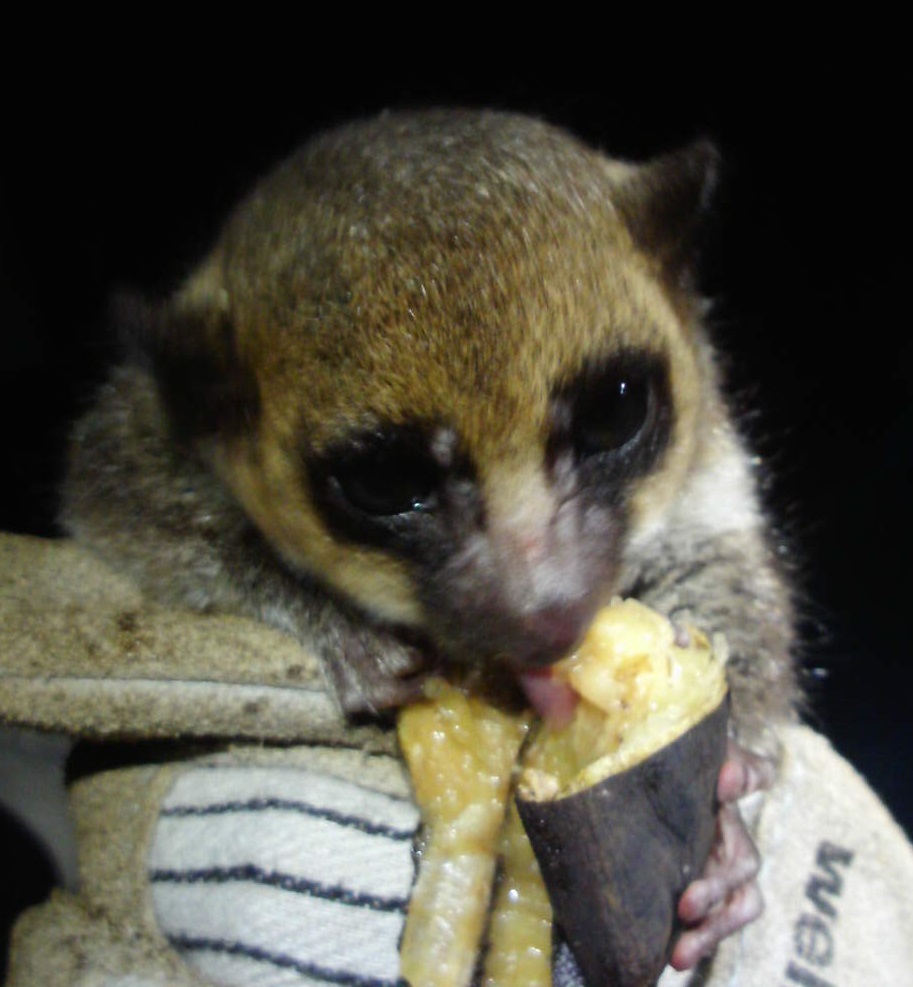
In his research, James studies dwarf lemurs. These lemurs are small (300g, 9-10 oz, about the size of a squirrel), and nocturnal (active at night). There are seven species, some occur in dry forest where it only rains a few days a year, while other species live in rainforest where it rains every day. His favorite species is the one only found on remote mountain tops. . . so he gets to do a LOT of hiking in his research.

dwarf lemurs love banana_croppedDwarf lemurs eat insects and fruits, but love the sugary nectar of flowers. When they visit flowers, they get the powdery pollen on their faces, and then, like big cuddly bumble bees, they spread the pollen to other flowers in their territory.

James is especially interested in the dwarf lemur species that live on mountain tops because they are so rare and unique. Studying these lemurs also provides him a great excuse to explore remote jungles and climb mountains. Some of the mountains he’s explored take two or three days of hiking through the forest to reach. and sleeping along the way. When he and his team reach the mountain, sometimes it can take two or three hours of hiking (up and up and up!) to get to the top.

One mountain, Maharira, was so remote and hard to reach it took two weeks of exploring just to find it! The forest on top of the mountain was totally different from the rainforest below. In the rainforests at lower altitude, the trees are big and tall (30+ meters, 90-100ft) with broad canopies that block out the sun, making the forest floor open. On the mountain tops, trees are short (10 meters, ~30 ft) with low, narrow branches and the sun reaches the forest floor, making it thick with vegetation.

Once James started searching for the dwarf lemurs, he realized there were two kinds on the mountain tops: some were large, brownish-red with long noses like the dwarf lemurs at low altitude, while others were smaller, grey-white with short noses and wide heads. How could this be? How do two species of dwarf lemurs that seem to have the same behavior and environment live together? Do they compete for food and shelter, or do they have different behaviors that allow them to coexist? Do they ever mix or do they only stay with their own kind? To find out, he spent three years trekking to lots of different places around Madagascar and searching for lots of animals.

Finding Dwarf Lemurs
Dwarf lemurs are the only primates that hibernate, like bears or groundhogs, but they don’t do it because it’s cold; dwarf lemurs hibernate when food is scarce. In the dry forests and rainforests, dwarf lemurs hibernate in the hollow cavities in trees, but on high mountains, they burrow underground. All these features make dwarf lemurs adaptable and interesting for research about their behavior and environment.

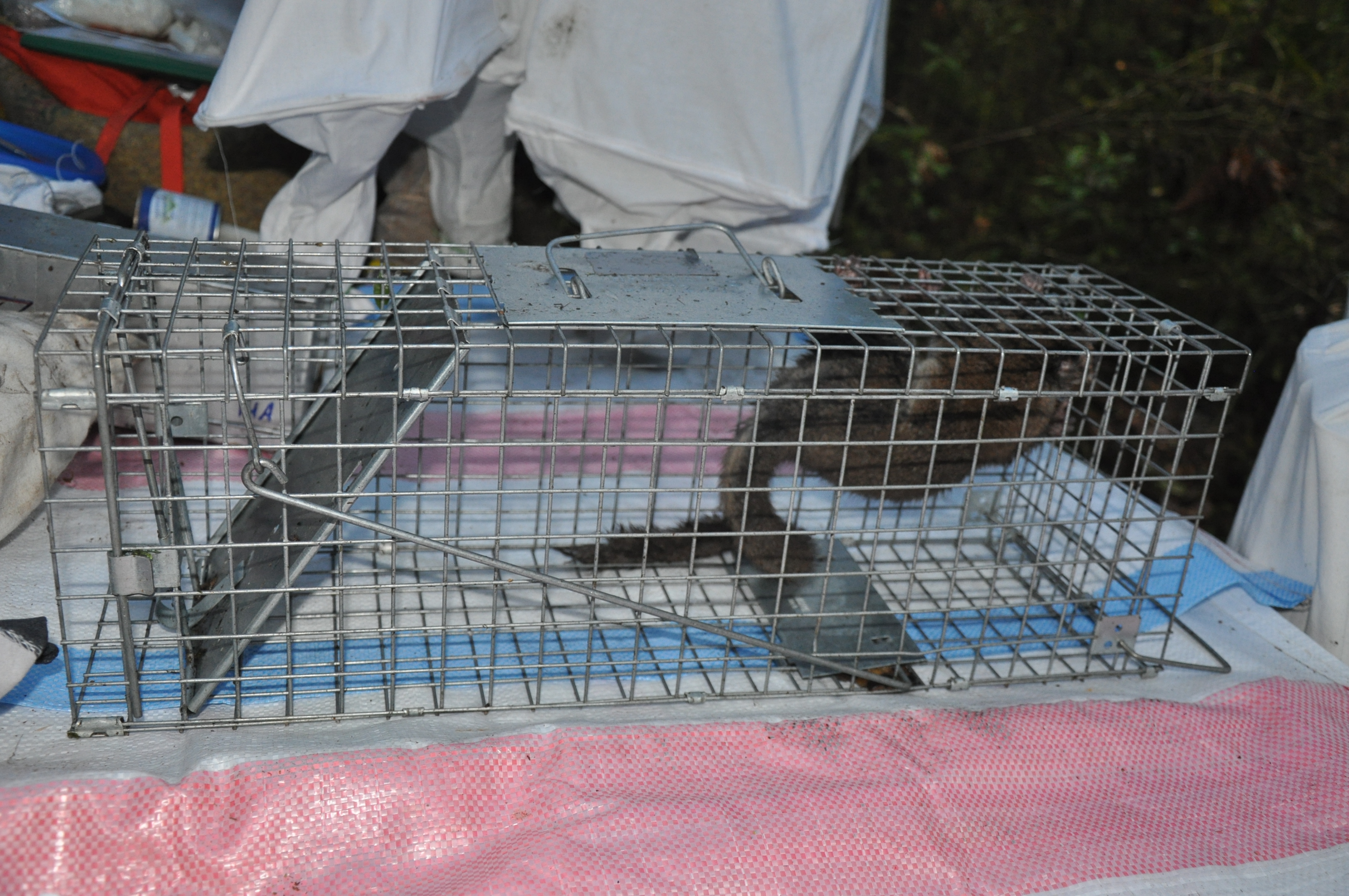
traps4James and his team catch the lemurs in big cage-like traps, so they’re safe and unharmed.

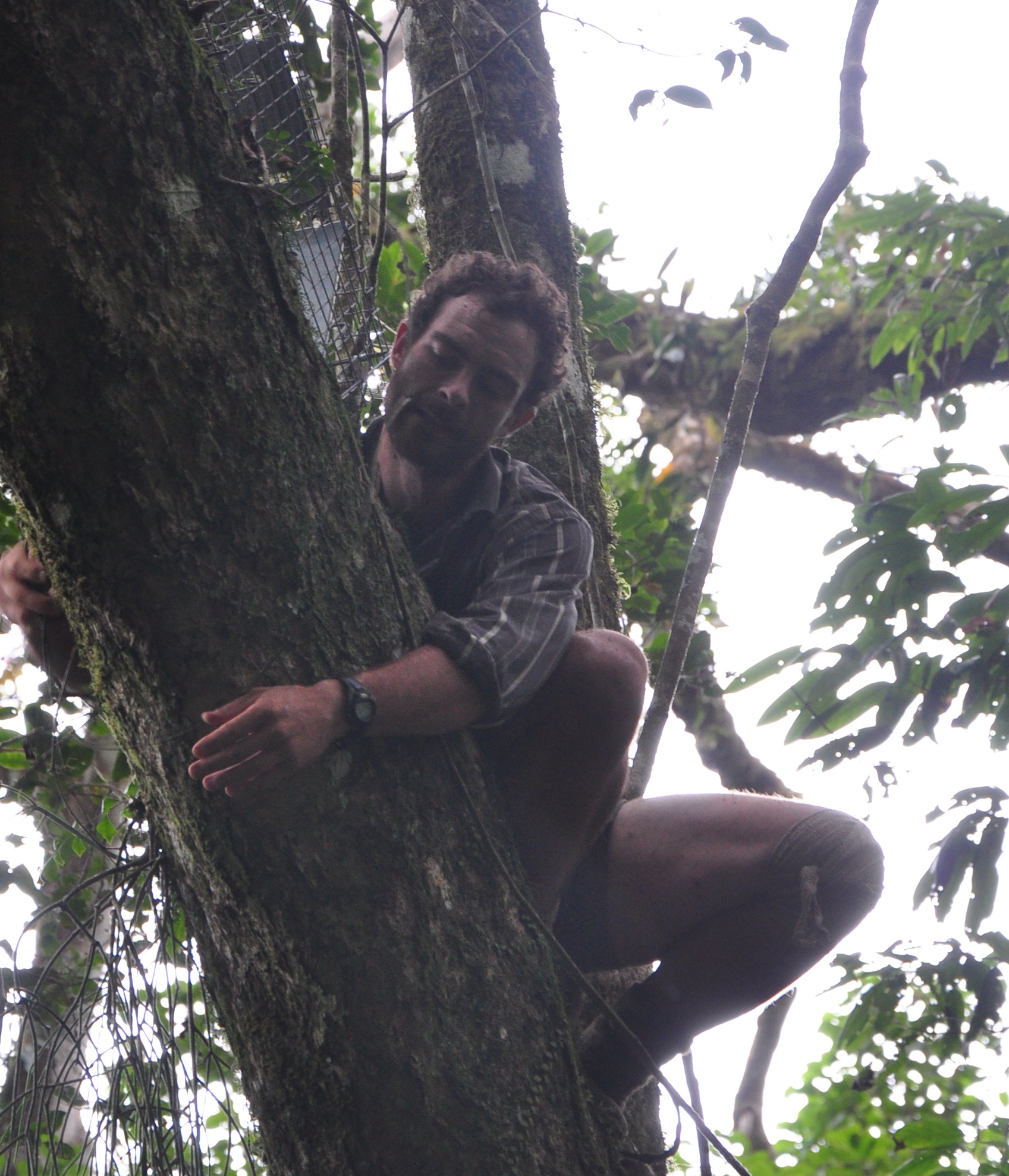
traps1_croppedHe has to set these traps way up in the trees, so he gets to climb tall trees in the jungle and see the jungle from high above.

James has several different camps around forests in southeast Madagascar. Some are low altitude, some are mountain tops, some are pristine, and others are heavily cut and disturbed by people. At each camp, he has trails all around the forest where he looks for lemurs and sets cage traps to catch them. Dwarf lemurs are small and go out at night, and also travel up in the canopy so it is hard to study them only by looking at them in the forest.

James and his team catch the lemurs in big cage-like traps, so they’re safe and unharmed. (Picture the cages you might use to catch raccoons or opossums in the backyard.) Another fun part about his research is that he has to set these traps way up in the trees, so he gets to climb tall trees in the jungle and see the jungle from high above. It is hard work, and just finding trees he can climb is hard, because the trees are usually tall, and they often don’t have branches until very high up. Sometimes he uses vines to help climb up to the first branches, and sometimes he uses small trees near-by to help him reach the bigger trees.

Once James is up there, he uses bananas, pineapples, sweet jellies, and other fruits to bait the traps. He sets up to 100 traps per night, but when he comes back in the morning, he’s lucky if he catches one or two lemurs. Dwarf lemurs are rare, and very hard to catch. Then he brings them back to his camp, where he takes pictures, measures and weighs them, and gives them little identifying marks by clipping their fur.

Then he keeps them in cotton bags and lets them sleep in his tent. When the sun sets, he releases them back to the forest and they go off on their way for the night. . . presumably with a crazy story to tell their friends!

James also searches for dwarf lemurs at night – which is his favorite time to go out! He describes the forest like this:

“The forest really comes to life at night. There is an endless chorus of frogs, crickets, owls, and sometimes even lemurs! Yes, many of the lemurs that go out at night stay in touch with their friends by making loud calls that can travel up to half a mile! Sometimes it can be a little spooky, like when it’s so dark that you can’t see at all. But we bring big powerful flashlights so we can spot the lemurs high up in the trees. Sometimes it’s not all fun, like when it rains. Rain at night seems so much worse than during the day because it gets cold, and being wet and cold can be annoying. And slipping in the mud in the dark is never fun! But sometimes when I take a big fall and land face-first in the mud, I just have to laugh and remember I love to be in the jungle and it’s not always fun and games. Because then the special moment comes when I actually do find one of the little lemurs high up in the trees and I get to make observations of the animal’s behavior in their natural environment. It’s a special feeling to see the animals foraging for food, socializing, and to see them bounce through the trees with such ease and grace even though it’s total darkness!”

Malagasy People

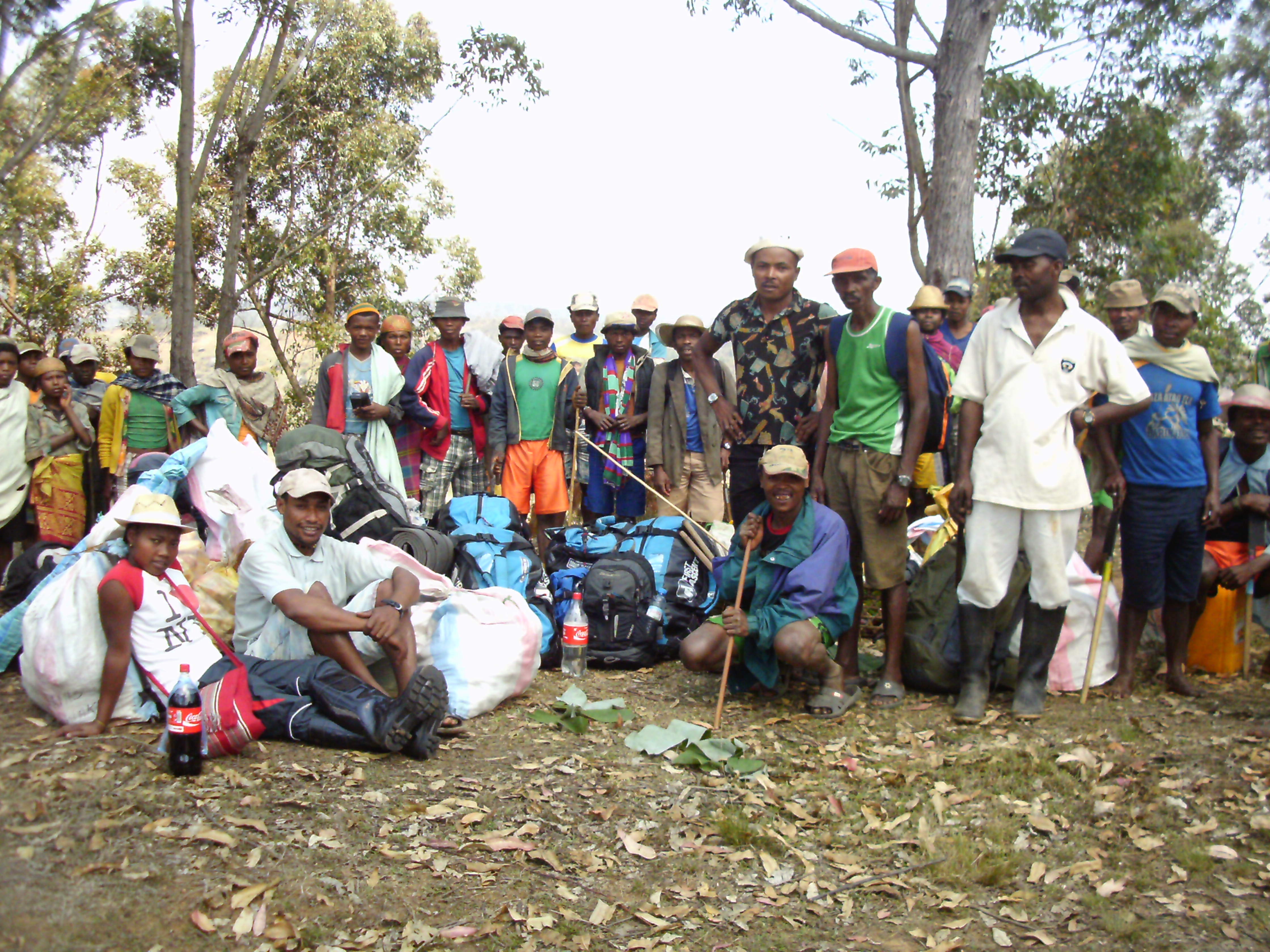
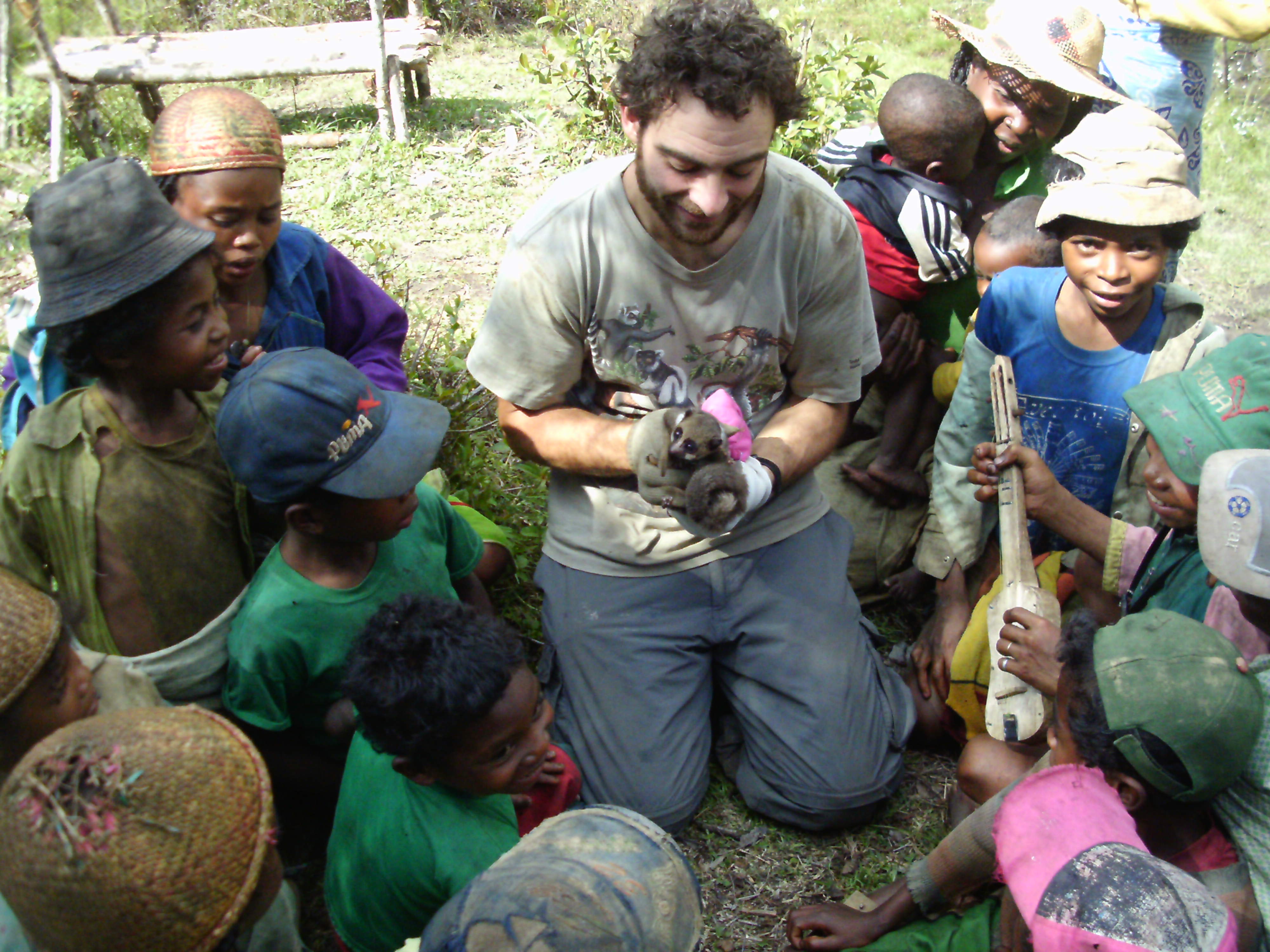
getting ready for a big expedition with local peopleSometimes James has a team of ten to twenty assistants, all local people from the places he explores.

James loves working in Madagascar because he loves the Malagasy people. He describes them as “fun, loving and giving.” Even though Madagascar is one of the poorest countries in the world, the people regularly offer him food and shelter, even when they have so little.

“The people, culture and language are so different from in America, it was a big shock at first, but then it started to seem like home. I have a team of Malagasy people that work with me. One is a student from the University in the capitol city. Lydia has been working with me since the beginning and has been a huge help to run my research project. She helped me learn the language, communicate with the people, collect data on lemurs, and do education and outreach projects with local people. She is always motivated and has a big smile, even when we’ve lived in the forest for one year with no shower!”

James also has a team of research assistants that he met in villages near the forest. Sometimes he has a team of ten to twenty assistants, all local people from the places he explores. He teaches them about lemurs, teaches them how to do research, and pays them for their help. This way they make money and learn about the environment. They are great because they know so much about the forest already—more than most scientists—and they teach James so much about Madagascar plants, animals and people.

The Results
James’ results suggest the small grey dwarf lemur species is a “specialist” that only lives on mountain tops while the other species occurs both on the mountain and at low altitude. It does not appear that the two species are mixing, and they don’t seem to change their behavior. The grey dwarf lemur species seem to be better adapted for the colder, drier environment on the mountains than the species found at low altitudes as well.

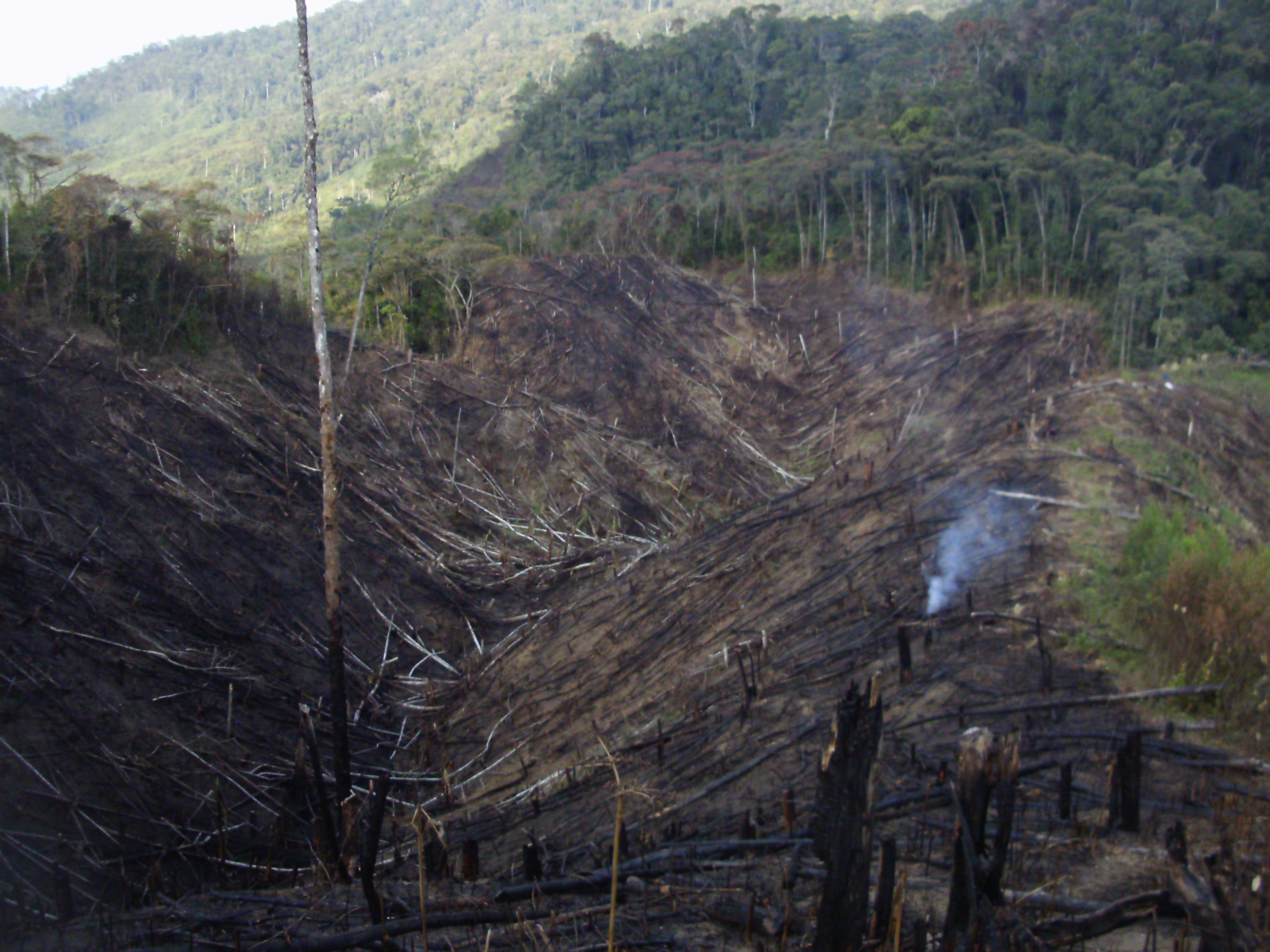
deforestation around mountainsThe high mountain forests where the grey species lives are highly threatened by human activities.

James’ research continues, and to prove his ideas, he wants to track the same animals year after year. This will allow him to see which animals survive longest, especially after their hibernation, when many animals may not survive.

Most importantly, the high mountain forests where the grey species lives are highly threatened by human activities. People cut and burn the forests to farm, first low on the mountain, but as the land gets used up, the farmers move higher and higher. Now, most mountains are separated from each other by grasslands and farms, so lemurs on one mountain cannot cross to the next mountain to mix and increase the populations. James says,

“I want to protect the species and their mountain habitats, and work with the local people to stop deforestation and plant trees to help the forest grow back faster. I want to keep working with the Malagasy people, encouraging them to save the forest, protect the animals and showing them ways to improve their lives by protecting the forest as well.”

On behalf of all the lemurs in Madagascar, I say a big “Thank you!” to James for all he is doing for lemurs and lemur conservation!

James Herrera is a Ph.D. student at Stony Brook University, New York. He conducts biodiversity research combined with education and capacity building for local Malagasy communities on the frontier of natural habitats. His goal is to motivate local stakeholders to conserve their natural lands. His research aims to uncover the links between the natural environment and lemur biology. Most important, he hopes to understand how humans are impacting the wildlife and environmental degradation.

Hans and Jen Hartvickson write books and stories for elementary students under the pen-name “Mister Lemur.” Their newest title, The Scheming Lemurs: Rivals in Rhyme will be available in November 2014. Leveled for grades 3-4, this fictional story features a group of lemurs on an adventure in Ranomafana National Park and Madagascar’s capital city of ‘Tana. Hans holds a bachelor’s degree in Economics from Stanford University and an M.B.A. from The University of Pennsylvania’s Wharton School. Jen earned a bachelor’s degree in Sociology and a master’s degree in Education from Stanford University. Visit www.misterlemur.com
Posted in Mister Lemur

Black-and-white ruffed lemur

Videos

Photos

ruffed_andrea (1)
ruffed_andrea (2)
ruffed_andrea (3)
Posted in Mister Lemur